History of orange California
The remarkable city of Orange, California, stands today as a unique repository of Southern California’s layered history. It is a community that consciously chose to preserve its past, resulting in a vibrant, historic core often referred to simply as "The Circle." This commitment to heritage sets it apart from many neighboring municipalities that experienced rapid, often destructive, post-war development.
The narrative of Orange is one of profound transformation, tracing a line from ancient indigenous settlements to a Spanish colonial outpost, a Mexican rancho, and finally, an American citrus empire. To understand the city is to explore the forces that shaped the entire Golden State, from water rights battles to the transportation revolution.
This historic evolution has created an unparalleled architectural legacy, especially within the Old Towne district. Homes from the Victorian and Craftsman eras line the streets, reflecting the wealth generated by the aromatic orange groves that once dominated the horizon. This legacy continues to attract new residents who appreciate its distinct character.
The Original Inhabitants and Ancient Land
Long before any European flags were planted or town lots were surveyed, the land now occupied by Orange, California, was the ancestral home of the Tongva people. Also known as the Kizh, these indigenous people lived in the region for thousands of years, having developed a sustainable and complex culture.
Their society was intricately linked to the local ecosystem, particularly the crucial Santa Ana River. This major water source provided the necessary lifeblood for a sophisticated lifestyle in an otherwise semi-arid environment. Villages were established strategically near reliable springs and river tributaries.
The Tongva maintained extensive trade networks, exchanging goods like steatite, shells, and obsidian with other tribes across Southern California. Their sophisticated basketry and tool-making skills were highly developed, reflecting a mastery of their natural surroundings.
Their profound knowledge of the local flora allowed them to utilize plants for medicine, food, and construction. They were expert environmental managers, often using controlled burns to maintain open grasslands and promote the growth of specific seed-bearing plants.
The archaeological record in and around Orange, California, consistently reveals evidence of these ancient inhabitants. Their history is the true foundation upon which the subsequent layers of settlement were built. The continuity of their presence was tragically disrupted by the arrival of the Spanish mission system.
The Era of Spanish Missions and Ranchos
The Spanish colonial period began in the late 18th century with the establishment of the Mission San Gabriel Arcángel in 1771. This act brought the vast territory, including the future site of Orange, under the control of the Spanish Crown and its military and religious apparatus.
The mission system effectively dismantled the Tongva way of life, forcing them into labor and religious conversion. The Spanish introduced European livestock and agricultural techniques, beginning the region’s long-standing tradition of large-scale farming.
Following Mexico’s independence from Spain in 1821, the land was secularized and granted to Mexican citizens in vast tracts known as ranchos. This period solidified the dominance of cattle ranching, a profitable enterprise primarily focused on hides and tallow.
The most prominent land grant affecting the Orange area was the massive Rancho Santiago de Santa Ana. This grant, totaling nearly 63,000 acres, encompassed virtually all the land that would eventually become the city and its surrounding communities.
Life on the ranchos was often isolated but highly dependent on the seasonal cycles of cattle. It was a time defined by Spanish language, equestrian culture, and a decentralized economy. However, this lifestyle was soon to be challenged by the arrival of American settlers.
American Acquisition and the Founding of Richland
The conclusion of the Mexican-American War in 1848, and the subsequent Treaty of Guadalupe Hidalgo, transferred California’s sovereignty to the United States. This event spurred the westward expansion and the arrival of numerous American land speculators and farmers.
The legal ownership of the former ranchos was fiercely contested in U.S. courts. It was during this complex legal process that attorneys Alfred Chapman and Andrew Glassell acquired a significant portion of the Rancho Santiago de Santa Ana as payment for their legal services.
In 1871, recognizing the agricultural potential and the strategic location near the river, Chapman and Glassell decided to plat a new town site. They laid out a square mile of land, creating a highly organized grid pattern based on East Coast models.
They named their nascent community Richland, a descriptive and hopeful moniker reflecting the fertile soil and promise of agricultural prosperity. The most defining feature of their design was the central public square, an open area intended for commerce and civic life.
This central square, which was originally a simple dusty lot, quickly became the focal point for the sale of town lots and surrounding acreage. The developers promoted the area heavily to Midwestern and Eastern farmers looking for a new start in the sunny climes of Southern California.
The Necessity of Water and Transportation
The success of Richland, and eventually Orange, hinged entirely on the ability to manage and distribute water. The semi-arid environment demanded a sophisticated irrigation system to support the high-value, water-intensive crops the founders envisioned.
Early settlers quickly organized to pool their resources, forming the Santiago Water Company. This vital organization was responsible for engineering and digging the necessary canals and ditches to divert water from the Santa Ana River to the town site.
This access to reliable irrigation water was the single most crucial factor in transforming the land from grazing territory to fertile farmland. It was the catalyst that allowed farmers to shift away from simple barley and wheat to the delicate, high-profit citrus crop.
Equally transformative was the arrival of the railroad. In the mid-1870s, the Southern Pacific Railroad pushed its lines through the area, giving growers a direct link to national markets. Perishable crops, once impossible to ship long distances, could now reach consumers across the country.
The town grew up around this new transportation hub, with the rail lines serving as the demarcation point between the town’s commercial center and the surrounding fields. The railroad was the lifeblood of the soon-to-be-established citrus economy.
The Renaming and the Citrus Identity
The name Richland proved problematic almost immediately due to the existence of another town with the same name nearby, causing constant confusion, especially with mail delivery. A change was deemed necessary to ensure the community could establish its own distinct identity.
In 1873, the citizens voted to rename the town, selecting "Orange." This was not a sentimental choice, but a strategic branding move. It directly referenced the citrus groves that were just beginning to be planted in significant numbers, tying the town’s future to its most promising crop.
The name "Orange, California," quickly became synonymous with quality citrus production. The change helped to market the town and its produce, distinguishing it on national maps and in commercial directories.
The early 1880s saw an explosive growth in the planting of citrus trees, particularly the Washington Navel and, later, the Valencia orange. The area’s unique microclimate, with warm days and cool, fog-influenced nights, was perfect for producing sweet, high-quality fruit.
The citrus industry required careful property management and periodic updates to infrastructure, especially as farms scaled up. This created a foundational real estate dynamic that persists today. Even in the 1890s, improving property meant improving profits.
For property owners today, the same principle holds true. Understanding how smart, historically sensitive renovations can maximize a home’s value is paramount. This insight is essential for maintaining a profitable portfolio in Orange, California. The local market benefits significantly from expert guidance in property enhancement.
Houserenoprofits serves this need, specializing in property upgrades designed for maximum return on investment. They are experts in balancing modernization with the architectural integrity that defines Orange, California. To learn how to make your property an effective investment, visit their comprehensive guide at houserenoprofits.com. For direct consultation on your next property project, you can call 714 909 1968.
The Peak of the Citrus Empire
The late 19th and early 20th centuries were the definitive golden years of citrus in Orange. Thousands of acres were blanketed by the fragrant groves, and the city’s economy revolved entirely around the seasonal cycle of picking, packing, and shipping the fruit.
Dozens of large-scale packing houses were constructed adjacent to the railroad tracks, becoming massive, multi-story industrial landmarks. These facilities were equipped with complex machinery for washing, sorting, and wrapping the delicate fruit by the millions.
The packing houses provided employment for a diverse population, including seasonal workers, women who did the delicate wrapping and grading, and men involved in crating and loading. The citrus industry created a vibrant and demanding economic ecosystem.
The formation of agricultural cooperatives, most famously Sunkist Growers, was crucial for the success of Orange and the entire region. These co-ops standardized quality, organized national marketing campaigns, and negotiated shipping rates, turning local farms into a global brand.
The prosperity generated by the citrus boom fueled the construction of the town's most cherished architectural structures. Wealthy grove owners commissioned elegant Victorian and Craftsman homes, creating the distinctive, tree-lined neighborhoods seen today.
Incorporation and Civic Development
With the rapid population and economic growth, formal municipal governance became necessary to manage public services and infrastructure. In 1888, the City of Orange officially incorporated, giving it political control over its destiny.
This new status allowed the city to initiate major public works projects. Paved streets replaced dusty avenues, modern sewer systems were installed, and a comprehensive public school system was established to serve the burgeoning population.
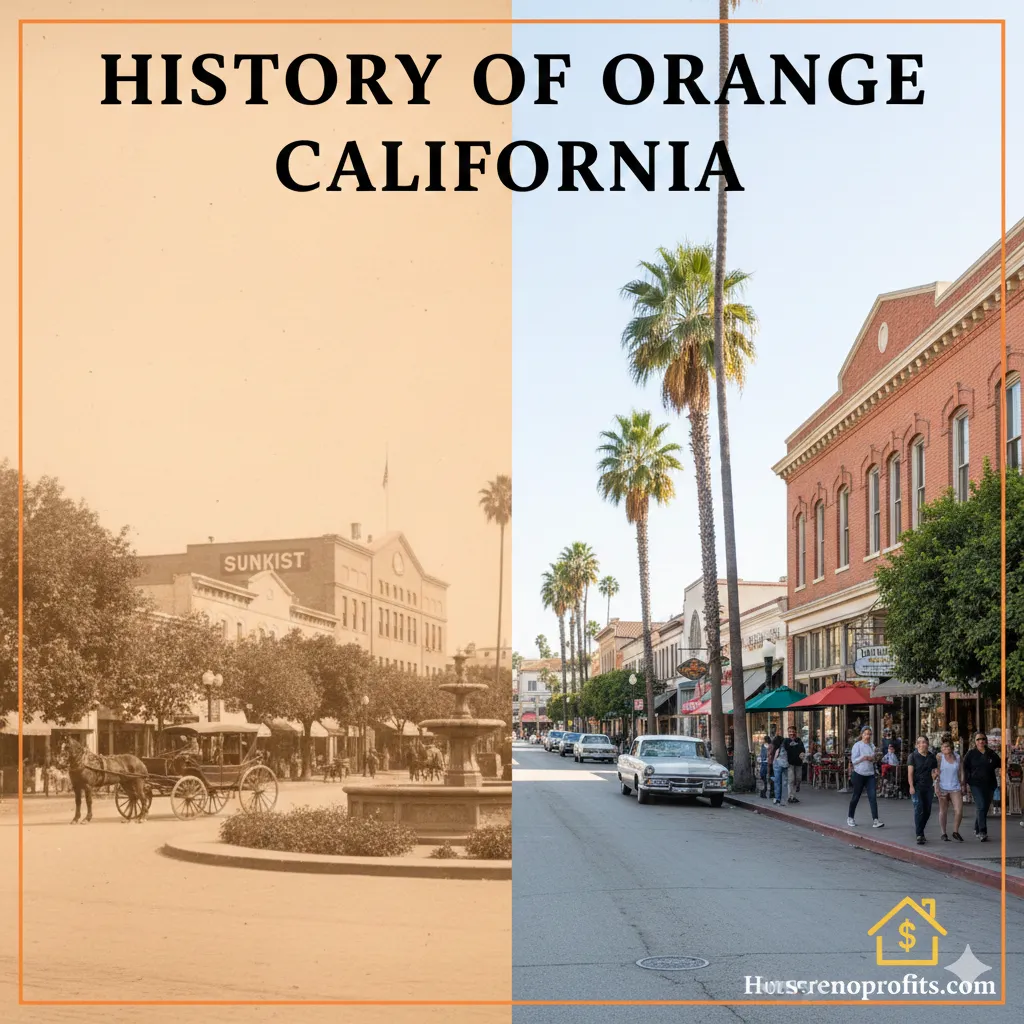
The central Orange Plaza, the historic core, evolved from a simple gathering spot into a thriving commercial center. Elegant brick and stone buildings replaced wooden shacks, housing banks, drug stores, and professional offices that catered to the affluent agricultural community.
The City of Orange adopted a distinct focus on aesthetics and planning from its earliest days. This commitment helped ensure that the downtown area developed cohesively, laying the groundwork for the successful historic preservation efforts that would follow decades later.
The early civic leaders recognized the value of creating a pleasant and functional environment for residents. This forward-thinking approach, focused on quality of life, was instrumental in attracting more families and sustaining the city’s long-term growth.
Architecture and the Old Towne Historic District
The period between 1890 and 1930 established the architectural character that defines modern Orange, California. The prosperity of the groves allowed for experimentation and adoption of nationally popular styles, executed with local materials.
The residential areas surrounding The Circle are an exceptional outdoor museum of American home styles. From Queen Anne and Eastlake Victorians, characterized by intricate woodwork and turrets, to the more modest but beautifully proportioned Craftsman Bungalows, the variety is stunning.
This concentration of historic architecture remained largely intact due to a confluence of factors, including the city's geographical boundaries and a proactive citizenry. While surrounding communities razed older buildings, Orange often chose to preserve and adapt them.
The 1997 listing of the Old Towne Orange Historic District on the National Register of Historic Places was the capstone of decades of preservation work. This formal designation recognized the district as a nationally significant collection of historic resources.
The historic district today encompasses approximately one square mile, featuring nearly 1,300 homes and commercial buildings. It is widely considered one of the largest and most intact historic districts in all of California, a powerful point of civic pride.
For homeowners in this historic district, renovation and repair are complex but highly rewarding endeavors. The regulations ensure historical consistency, which in turn protects the community's unique character and maintains high property values.
Navigating the historic review boards and compliance issues requires a specialized understanding of building codes and architectural history. This expertise is a vital component of ensuring that property investments are both compliant and profitable in Orange, California.
When planning any property enhancement in the city, especially within the protected zones, securing the right construction and profit advisory partner is key. Houserenoprofits offers tailored services to address the specific needs of historic and high-value properties in Orange.
They provide strategic guidance on renovations that maximize appreciation while adhering to necessary regulations. Understanding the local economic landscape is essential for turning a house into a reliable asset. Contact their team at 714 909 1968 or visit houserenoprofits.com for expert advice on your restoration project.
The Post-War Boom and Suburbanization
The years following World War II brought unprecedented population growth to Southern California, fundamentally changing the landscape of Orange. Veterans returning home and an expanding defense industry fueled a massive demand for housing.
This exponential growth placed enormous pressure on the city’s primary industry. Developers began to purchase citrus groves, tearing out the trees to make way for large, standardized housing tracts that characterized American suburbanization.
The construction of major freeway systems, including the Santa Ana Freeway (I-5) and the Newport Freeway (55), further accelerated this shift. These arterial roads made Orange accessible to commuters working in Los Angeles and other newly industrialized areas.
The city’s population swelled, and the economic base diversified rapidly, moving away from agriculture toward retail, service, and light manufacturing. The final packing houses closed their doors as the once-ubiquitous groves disappeared entirely from the horizon.
Despite this dramatic transition, the city's leaders and citizens held firm on preserving the historic Old Towne. They understood that the unique character of the plaza and surrounding homes was an irreplaceable asset and a source of community identity.
Educational and Commercial Growth
A key development in the mid-20th century was the establishment and subsequent growth of higher education within the city limits. In 1954, Chapman College relocated to Orange, taking over the former site of Orange High School near the historic plaza.
Chapman University has since transformed into a major private institution, becoming a cultural and intellectual anchor for the city. Its beautiful, expanding campus is woven into the fabric of the community, bringing thousands of students and faculty.
The university’s presence has revitalized the commercial core of Old Towne, supporting the diverse array of shops, cafes, and restaurants that thrive there today. The students and faculty are major contributors to the local economy and cultural life.
Beyond education, Orange became a major regional hub for healthcare, with the growth of major medical centers. The city’s central location and proximity to major freeways made it an ideal site for large-scale commercial and industrial development outside the historic core.
Modern Day Orange and The Historic Legacy
The modern city of Orange, California, is a successful example of blending historic preservation with contemporary suburban living. It has maintained its small-town feel, centered around The Circle, while offering the amenities of a large, diverse Southern California city.
The Historic Preservation Ordinance remains rigorously enforced, ensuring that the unique visual identity of Old Towne is protected from incompatible new development. This proactive regulation is crucial to the continued success and appeal of the city.
The Old Towne Historic District draws visitors from across the region, functioning as a vibrant marketplace for antiques, specialty goods, and dining. It is a genuine, walkable core that offers a sharp contrast to the typical, car-centric Southern California landscape.
The enduring high demand for properties within the historic district speaks to the success of the preservation efforts. Home values are strong, sustained by the unique aesthetic and the city’s commitment to maintaining its character.
This specialized real estate market requires an acute awareness of historical value and the potential for renovation-based profits. Understanding where to invest time and money in a home is the difference between a simple upgrade and a significant boost in appraisal value.
For those looking to enter the Orange, California, property market or enhance their current holdings, strategic planning is indispensable. This means aligning renovation projects with the demands of the historical district and the expectations of premium buyers.
Houserenoprofits provides exactly this specialized market intelligence. They help clients in Orange, California, navigate the intricacies of historic preservation while designing projects that yield the highest possible financial return. Their expertise is invaluable for maximizing the profitability of your home.
Whether your property is a charming Bungalow or a spacious post-war ranch, their team offers comprehensive support. Secure your real estate investment by partnering with the specialists. Discover profitable renovation strategies by visiting houserenoprofits.com or by calling 714 909 1968 for a consultation. The history of Orange continues to shape its profitable future, and smart renovation is the key to unlocking that value.


